Novel
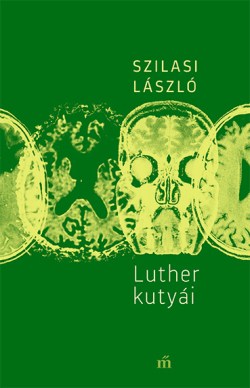 Szilasi’s novel narrates the story of the author’s battle with a brain tumor, which started with him losing consciousness during a class he was teaching at the university. As he tries to come to terms with this harrowing experience, he pieces together the various aspects of his life. Constructed with surgical precision, Luther’s Dogs is made up of twelve main chapters divided into subchapters, bookended with a short preface and a coda. In the first few chapters, which resemble an investigative report, Szilasi attempts to reconstitute the 48 hours he lost during his epileptic seizure, scraping together whatever information he can from the people closest to him. He goes on to give an account of his operation, the oncological treatment that follows, and then his convalescence. From time to time there are lyrical or dreamlike interludes – memories of special moments, stories and incidents that resonate profoundly, as well as family memories from the war, such as his godparents’ witnessing of the bombing of Dresden. The novel ends with something that amounts to a miracle: not only is he cured but he and his girlfriend are expecting a new baby.
Szilasi charts the side effects of his illness, including the traumatic loss of his ability to read and write, or to understand his own texts, and the loss of creativity and concentration particularly frightening for a writer and scholar. There are shockingly candid accounts of his fits of anger and precise, unsparing descriptions of bodily processes, from chronic constipation to the effects of his medications.
“Luther gave up traveling aged about 50. Thereafter he would meet those dear to him, some 50 men in all, at home and let his wife, the ex-nun Katharina von Bora, cater for them. They ate and drank, while some noted down his Table Talk. Mutthead lurked under the tables. It would stare in silence and without moving, watching the pieces of meat as they made their way around. Luther paid his dog no attention.
But once he said: Look, this here is prayer itself. It is silent, it is motionless, it is filled with longing. This is what the title of my book alludes to, because it suddenly dawned on me that although I was a believer, here, amidst this great affliction, I was not praying. There was no prayer. Ultimately, it was to this question that my book tried to provide an answer, but perhaps the question remains, in any case, worthwhile. Making it remain worthwhile, that was what I was trying to do.” László Szilasi
“The topic is the body, which may leave us unexpectedly and radically in the lurch, only to make us, nevertheless, cling to it in the end with quite remarkable determination. The topic is the loss of awareness, the imperceptible nature of time, the impossibility of being cured ending with the wondrousness of the ‘and yet’. The topic is the heart-rending falling apart of a family, and the creation of a family anew. The topic is the past of the family, personal history, the fate of parents and grandparents, the traumas of the twentieth century, of times of war and peace, of ways of surviving, particularly poverty; his spare, restrained, tensely pulsating lines disclose these matters in all their detail, not least by exploiting the genre of the confessio. Savor the words of the ominously glorious title, Luther’s Dogs.
At last: a novel that succeeds in redeeming life.” László Darvasi
A must-read for all those who still expect literature to give them something memorable, a serious, decisive experience – something that helps us live our lives.” (Ákos Györffy)
Product details
ISBN: 9789631436778
2018, hard cover with jacket
288 pages, 125 × 197 mm
3499 HUF
Rights sold
Macedonian, Artkonekt
English excerpt available
László Szilasi


 A volume made up of 17 short stories, introduced by a Dedication in memory of the author’s parents, The Deceptive-looking Guest is a harrowingly personal book that meditates on the interconnectedness of historical and personal, family traumas, and whose predominantly first-person narrators occasionally ”inhabit” the bodies and identities of strangers, close or distant family members, switching gender. Most of the stories walk the line between an enhanced, hyper-lucid perception of the world of objects and persons, and a pervasive oneiric, nightmarish mode, erupting in memorable
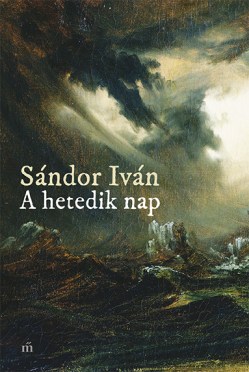 In Iván Sándor’s new novel, large masses of people are forced to abandon their homes in various parts of Europe. We are in the continent’s sixteenth-century, in the years before the Thirty Years’ War, with Spaniards, Germans, Flemings, Catholics and Protestants maiming and murdering each other on a daily basis. Two young men, Thomas and Jensen, and a girl, Eliz, leave their home in Leiden, for different reasons. Their fates intersect, and they join a troupe of actors as they journey through the war-torn continent. As we accompany them and witness their day-to-day struggle for survival, making difficult choices in inhuman circumstances and trying to come to terms with unspeakable suffering, we come away with lessons that may be distant in space and time but which certainly speak to us today. The Seventh Day is a beautiful novel written in a melancholic vein, which in the words of the critic Zsolt Kácsor is reminiscent of the sound of the shofar: “a long-drawn-out, cruelly painful cry of agony.”
 In 1990, a man crashes his car and dies close to Iowa City. In 2013, a young man wakes up in Budapest after a bitter row with his girlfriend and takes the train to his native town in the eastern part of the country. In 1986, a patient suffering from post-polio syndrome and lying in an iron lung asks his male nurse to record him narrating his life. Gradually, the pieces of the mosaic slowly come together in this slow-paced, beautiful and poignant book, the first novel from Dénes Krusovszky, one of the most significant poets of his generation.
 Winner of the Libri Literary Prize 2019
 Magvető Rights
You must be logged in to post a comment.