

Uncategorized

Gábor Schein: Swedish

Novel

Könyv: Svéd (Schein Gábor)

After the 1956 revolution in Hungary, a childless Swedish civil servant adopts a Hungarian boy from a refugee camp in Austria. He and his wife never tell the boy, Ervin, that he is not their son by birth. Although they firmly believe that they gave Ervin a much better life than he would have been given by his original family, father and son gradually become more and more estranged, due to unspoken secrets and the absence of spontaneous feeling.

Trying to understand what went wrong between them, the father travels to Budapest to search for Ervin’s roots, on the basis of what scant information he was given at the time of the adoption. His search leads him to a psychiatrist in Budapest’s most renowned psychiatric hospital. Dr Bíró shows Mr Grönewald documents which prove that Ervin’s mother, a zealous communist, had been an inmate in that hospital after the 1956 revolution.

The father’s search for meaning is juxtaposed with the predicament of Dr Bíró, the dedicated psychiatrist, who is obliged to look for a job when the psychiatric hospital is closed down 139 years after its foundation – a scandalous piece of contemporary Hungarian history (the hospital was indeed closed down in 2007).

Can we leave our painful memories behind and still find our place in the world? This is the question raised by Schein’s beautifully written, meditative and low-key narrative of identity and memory, sanity and madness.

Can we leave our painful memories behind and still find our place in the world?

Product details
ISBN 978 615 54 5474 5

Kalligram, 2015, hardback
208 pages, 3499 HUF

English excerpt and complete German text available

Rights sold
Spanish, Acantilado
German, Friedenauer Presse

Gábor Schein

Uncategorized

Gábor Schein: We’ll Still Be Here

Novel

Megleszünk itt · Schein Gábor · Könyv · Moly

Kiefer, a maths teacher who lives alone and isolated in a provincial town in eastern Hungary, realizes that his life and his job are aimless and pointless. Once a talented and promising mathematician, he decided to move to this small town with his sister, a librarian, to teach in the local high school. After losing his sister and his job, Kiefer, considered a weirdo by the townspeople, decides to give up his former life and moves to a hut on the outskirts of town to complete a human experiment, conducted on himself. With harrowing accuracy, he notes down his reflections on the nature of power and on the devastation in and around him, as well as in the world at large.

The novel’s other thread involves a couple in their forties who are living through a marital crisis. Ágnes, who works as a typesetter, and her lawyer husband Zoltán, have an unhappy marriage. They have serious communication problems. While their characters are diametrically opposed, they nevertheless belong together. Ágnes moves to Zoltán’s father’s farm with their child, close to the town where Kiefer lives. The couple meet Kiefer, who is profoundly affected by this encounter.

Kiefer is a memorable character who lives a life of destitution and hopelessness but sees very clearly the social and political processes around him and in the wider world. In a way, his craziness and withdrawal from a world whose laws he is unwilling and unable to accept make more sense than the struggles of the ‘normal’ people in his milieu.

Rich in thematic motifs and narrative threads, Gábor Schein’s novel attempts to answer the question of what a person can do with their life, and what separates yet binds together people who are neighbours, but completely alienated from their own existence.

Man, first and foremost, fears for his own skin, wishing only to live in comfort, and for that reason comes to believe in violence, just as long as it is directed towards others, and even when — to his own misfortune — he himself becomes a victim. But above all, he always chooses a form of conduct he finds familiar, even if that makes him suffer.

Product details
ISBN 978 963 14 3856 7

2019, hardback
236 pages, 3699 HUF

English excerpt available

Gábor Schein

Uncategorized

Gábor Schein

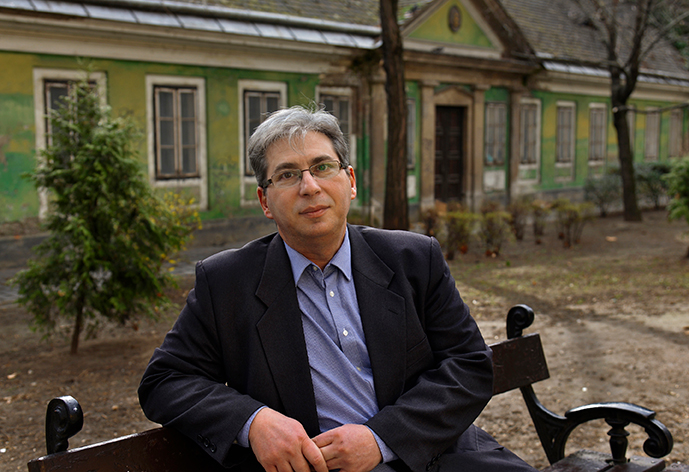
Born in Budapest in 1969, Gábor Schein is one of the leading writers of the middle generation in Hungary. Schein has published a number of books in a variety of genres, including poetry, fiction, theatre plays and a libretto (staged by the Munich Opera), literary history and criticism, as well as books for children. He is the author of five novels to date: The Book of Mordechai (2002), Lazarus (2004), The Autobiographies of an Angel (2009), Swedish (2015) and We’ll Still Be Here (2019). Schein’s political essays have been published both in the Hungarian liberal press and in international papers such as the Frankfurter Allgemeine Zeitung. He is the recipient of the prestigious Attila József and Milán Füst literary prizes.

We’ll Still Be Here
Swedish
Autobiographies of an Angel
Oh, Rhinoceros

Uncategorized

Boldizsár Fehér: Blind Monkey

Novel

feher_boldizsar_vak_majomTwo Nobel Prize winning scientists announce to the residents of a luxury hotel in Paris that in the next few days they will be taking part in an experiment. The story is told by a young man in his twenties, until recently Hungary’s richest person, but now on the run from the police. He tries to find refuge in the hotel where the curious experiment is taking place.

Blind Monkey tells the story of a young man who has effortlessly become the youngest Hungarian multimillionaire – a Hungarian Gatsby – but fails to live up to his responsibilities. His corporate empire collapses, and he finds himself in the middle of a corruption case. This finally shakes him out of his passivity and his conviction that provided he does not do anything, he cannot spoil anything either.

Though Boldizsár Fehér narrates this easy come, easy go story with lightness and humour, Blind Monkey tackles existential issues. Sitting in his Paris hotel, the narrator tries to make sense of more than just his own predicament: he reflects on the painful truth that although we are free to choose, the number of our possible choices is finite, and the decisions we take – as well as the decisions that are taken for us by others – gradually come to define our identity. Eventually he comes to understand that it is sheer laziness to blame others for our own unhappiness: we have no choice but to grow up. In the end, he accepts responsibility for the corruption, and will probably end up serving time in prison.

A witty and charming book, Boldizsár Fehér debut novel is an adventure story about responsibility and finding one’s place in the world.

“Here’s a tip for the evil people in this world: how to destroy someone’s life? The answer: give them everything they could have wanted.”

Product details
ISBN
978 963 14 3750 8
2018, paperback
125 x 197 mm

196 pages, 2999 HUF

Full English text available

Boldizsár Fehér