
Uncategorized

PANNI PUSKÁS: That Any Might Be Saved

Panni Puskás was hailed by critics as “provocative” and “punk”. Her novel is a set of monologues by three women from Budapest – two of them in their thirties, one in her fifties. They are talking to the reader as much as to each other, so that gradually we realize that though they seem to have nothing in common, these are in fact two sisters and their mother.
One sister works at a multinational in Budapest, and hates it. She spends her free time with drugs, smashing a BMW, pondering revolution, and waiting for something to happen. The other sister moved to Sicily, and lives in picturesque surroundings with her lover, an Italian girl whose eyesight is steadily failing. The boundless sea holds wonders, but horrors too: refugee boats are idling near the shore. Writing letters to a daughter, her mother relates her life starting from her teens, her pregnancy from a hip but obstinate boy, who left her to drop out of school into poverty.

Panni Puskás has her protagonists struggle to find meaning in their lives, as they try to comprehend, cope with or rebel against challenges posed by Hungary, Europe, and the world today. A batch of inadequate responses to meaningless consumerism, the migration crisis or a severely stressed mother-daughter relationship leave room for a subplot following the story of Santa Lucia, the patron saint of Siracusa.

Can we ever really save anyone? Ourselves, our family, loved ones, or even just random strangers who are suffering? In sweeping and refreshingly current narrative reminiscent of Sofi Oksanen, Panni Puskás is pushing her characters to find answers.

Provocative, fresh and punk

Product details
ISBN 978 963 14 4263 2
2023, paperback
232 pages, 4299 HUF

Rights sold
Serbian, Imperativ
Macedonian, Čudna Šuma
Bulgarian, Colibri

Panni Puskás

Uncategorized

RÓBERT MILBACHER: Bitter Waters

Novel

Róbert Milbacher’s new novel chronicles the life of a woman who had faced great physical and mental suffering, yet never had time to reflect. This book also chronicles a short-lived settlement in Slavonia (now East Croatia), founded in the 1860’s only to disappear without a trace in the onslaught of World War II.

The chapters present an alternating storyline, of a 19th-century village history from founding days to abandonment, with even-numbered chapters following the story of the author’s grandmother, progressing from her deathbed back to the enchanted world of her childhood days. Besides a rural community’s everyday pursuit of a better life, we also are confronted with a Hungarian-German ethnic family’s tribulations. Milbacher writes about people who do not shape history, but are burdened by it, even as each generation rekindles the hope for a better and fairer life, despite their hopes being dashed over and over.

A fragmented story is outlined in medical reports, archived documents, family anecdotes, awkward secrets, and word-of-mouth beliefs. With personal involvement and a solid historical background, the author portrays life and society from a vanished time, a world that paradoxically managed to live on in the impulsive reactions and choices of future generations. Róbert Milbacher vividly describes photos, and turns toward his parents’ and grandparents’ generations with an empathy that often brings to mind the novels of Annie Ernaux. A master of narrative, he is an author engaged in the individual and collective fates, struggles and coping mechanisms of people caught in ideological crossfire. Bitter Waters is a deeply personal and cathartic book.

Winner of the first Visegrad Literary Prize (2025) and the Artisjus Literary Prize (2024)

Product details
ISBN: 978 963 14 4275 5
2023, paperback
464 pages, 5999 HUF

Róbert Milbacher

Uncategorized

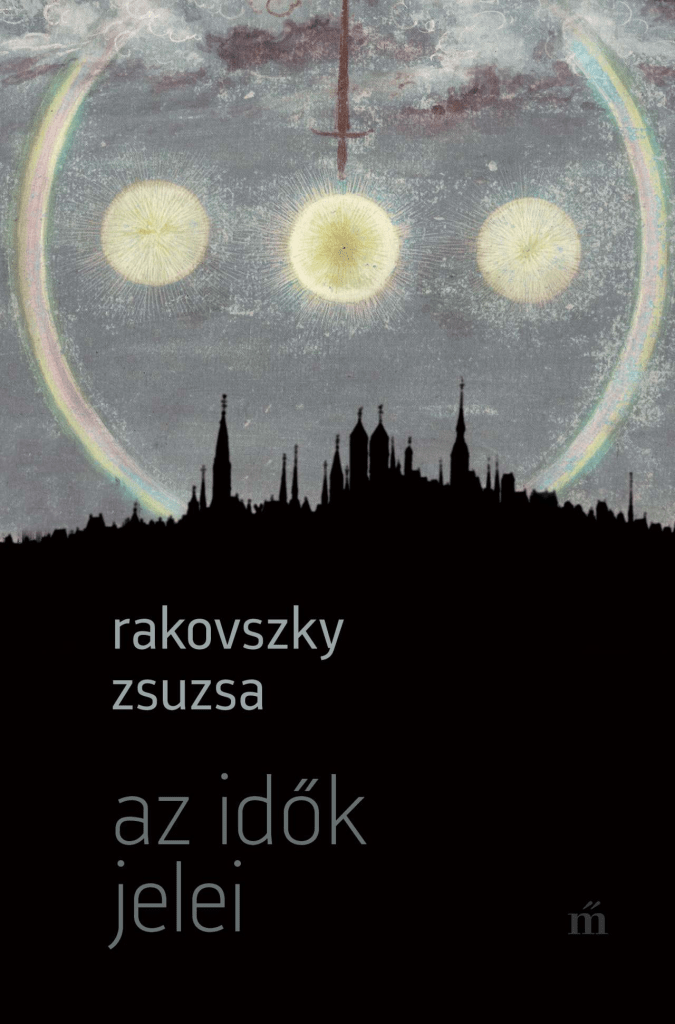
Zsuzsa Rakovszky: Sign of the Times

Münster, the 1530s. Tensions are growing between Catholics and Protestants. As emotions are running high, radical Anabaptists seize the city hall, and proclaim that Münster, under their rule, is the ‘New Jerusalem.’

The story of the Münster rebellion – a story of escalating religious fanaticism and revolutionary zeal, madness and terror – is told by an eyewitness, Liza, the mute servant girl, who sees and hears everything. As she cannot talk, people – including her master, Bernhard Knipperdolling, a wealthy patrician who becomes one of the leaders of the rebellion – readily speak their mind in front of her.

Sign of the Times is a historical novel in which almost all the characters are real and the events are true, even the most unlikely ones – the blind belief in two prophets (a former baker and a former tailor), the radicals’ introduction of polygamy, the massacre of the last days, and the gruesome revenge of the expelled bishop. Rakovszky has a remarkable talent for storytelling and for transporting the reader effortlessly into a world long gone, with all its paraphernalia and everyday activities.

However, this is not merely a historical novel: by recounting all the twists and turns of the story of the Münster rebellion as it relentlessly proceeds towards its terrible end, Rakovszky also tells a timeless story that is painfully relevant to our times: she shows how the legitimate grievances of people and their desire for freedom and justice can be used by impostors who, when they come to power, manipulate the people into complying with even the most insane demands.

Product details
ISBN 978 963 1442 37 3
2022, hard cover with jacket
312 pages, 5499 HUF

Zsuzsa Rakovszky

Uncategorized

JUDIT KOVÁTS: Children of the Tatra Mountains

Judit Kováts’s previous book, Expelled, concerned the fate of the German minorities expelled from Slovakia after World War II, seen through the story of Lilli Hartmann, a girl from Kežmarok (Hungarian Késmárk, German Käsmark). Children of the Tatra Mountains finds Lilli on a liner on her way to the United States with her new family: her husband, an adopted son, and a book of legends of the Tatras. As she leaves old Késmárk and the Tatra mountains steadily further behind, the past surfaces again and again in the form of memories and dreams, as well as stories.

Memories of hikes before the war and of the anguish of deportation are repeatedly interrupted by the stories: of the poverty-stricken folk of the Tatras, of Huschwai, the spirit of the Tatras, the caves with hidden treasure, and the glacial lakes that are formed of a mother’s tears. Meanwhile, the liner with the family on it steadily nears the New World, and when they land in New York Lilli must once again try to come to terms with her past.

In the pages of Children of the Tatra Mountains we are in transit throughout. Travelling between the Old World and the New, through the upheavals of twentieth-century Central Europe, between past and present and, above all, between reality and the life of the mind.

Writing a story in words is possible whether in one’s head, with a pen, on a typewriter, in a POW camp, in the loft of a Munich flat, or in America – and what we start, we must finish. Those were Papa’s words to me before he died, as he urged me to set myself a consequential goal, because being branded guilty by decree, hounded from house and home, and planted amid strangers makes one neither a pariah nor a second-class German!

Product details
ISBN 978 963 1441 73 4
2022, hard cover with jacket
288 pages, 125×30 mm
4499 HUF

Judit Kováts