
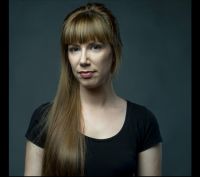
 Born in 1988 in Budapest, Anita Harag is the recipient of the György Petri Prize (2018) and the Péter Horváth Literary Scholarship (2019). This is her first volume.
Category: Uncategorized
ANITA HARAG: Rather Cool for the Time of the Year
Short stories
 Reading Anita Harag’s stories is a bit like watching an episode from a series that has been going on for many months. Nothing special happens to her characters: they wake up, go to work, visit their relatives. But if we take a closer look, these simple gestures and chores reveal complex relationships and are suffused with pain, desire and loss. The stories are always open-ended: we get a glimpse into the life of the characters, then leave them where we found them. The narrators of her stories – young women in present-day Hungary – are full of anxiety nurtured by the traumas and memories of their parents and grandparents, as well as their own fear of the future. They may be lonely but they are never alone: they are always shown in their relationships with their family members, lovers, friends or colleagues – in fact, it is their loneliness that connects them to one another.
Harag’s characters often seem like strangers in their own stories. A Ukrainian girl feels excluded in the office because she doesn’t speak Hungarian and spends her time trying to guess what people around her are talking about. Alone with her thoughts, even though her husband is with her, a daughter cleans up her alcoholic father’s house after his death, and tries to come to terms with his legacy. A ‘good’ girl meets a ‘bad’ boy, and as time passes, the girl starts to see herself thorugh her boyfriend’s eyes, her inner monologue becoming tainted with the way he sees her. Many of the stories are about loss, or the fear of loss: the illness or death of parents or grandparents, the fear of loving a person or an animal and then losing them, or the fear of being diagnosed with cancer.
As Lajos Parti Nagy said about Anita Harag, she is capable of balancing between what is significant and what is insignificant, revealing the momentous in the banal and the tragic in the petty.
“My mother spends less and less time in the kitchen […] Neither my brother nor I help her out, we’ve got used to Mother not needing any help. She can manage on her own, she’s been managing on her own for the last four years. We sit and watch her managing.”
Product details
ISBN 978 963 14 3948 9
2019, paperback
136 pages, 2999 HUF
Complete English translation available
Rights sold
German, Schöffling
Sándor Neszlár
 Sándor Neszlár was born in 1980 in Sátoraljaújhely. He has two books to his name: Inter Presszó (FISZ, 2009) and A Carpenter’s Stepson (Magvető, 2018). Neszlár works as editor with Csimota, a children’s publisher.
SÁNDOR NESZLÁR: A Carpenter’s Stepson
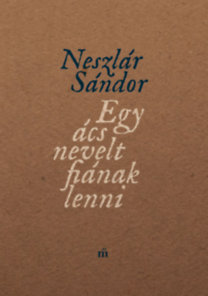
Sándor Neszlár’s book is exciting experimental prose: he writes a sentence for each kilometre he’s run. The novel is a sum of these sentences, brought to life by the runner’s thoughts, now focussed, now wandering freely. The sentences themselves are unusual: they are almost all impersonal, concealing their narrator. A Carpenter’s Stepson is a veiled autobiography that urges the reader, too, to explore the places of their own life, and run through their own sentences.
“It all started with running. I started noting the kilometres and then, after my runs, a sentence or two as well: running into someone while running; running into trouble. When I was nearing my thousandth kilometre, I decided this text would be one thousand sentences, but I ran faster than I wrote, so I had to make that one thousand one hundred and eleven to keep pace with myself. Meanwhile I went years without running, without writing too; later I picked it slowly up again, and as the kilometres piled up once more, the sentences began running out, but by then, that didn’t matter at all.”
53. Leaving blank pages in an unlined notebook. 54. Getting someone else (mum), while driving, to write down the following sentence: to see your favourite film for the first time. 55. Being a lizard on a sunlit rock. 56. During football, as a first year, to interpret literally the phrase: stick to him. 57. Bursting through a wall of linked hands to capture the flag. 58. Saying, look, a wasp, before killing it. 59. Knowing how to make light of grief after a funeral. 60. Driving through the sleeping city at night with your lights on full beam. 61. Deviating from the planned route and then saying:
we’re not lost.
EDINA SZVOREN: There Is None, Nor Let There Be
Short stories
Edina Szvoren’s stories contain a lot of dry humour, yet at the same time they sizzle, as she reveals the drama in the minutiae of human relationships. When describing Szvoren’s literary world, reviewers have brought up the names of two radically different predecessors: the analytical prose of Péter Nádas and the graceful giant of grotesque, Péter Hajnóczy. The stories of There Is None, Nor Let There Be will convince the reader that Szvoren is a mature author with a unique storytelling voice. The family, which is both the centre stage and model of our lives, stands firmly in the middle of the stories, regardless of whether we are struggling on that stage or are just on the outside looking in. (European Prize for Literature Anthology, 2015)
Product details
ISBN 978 963 1438 92 5
2019, hard cover with jacket
176 pages, 3299 HUF
Rights sold
Croatian, Naklada Ljevak
Italian, Mimesis
Dutch, De Geus
Macedonian, TRI Publishing Centre
Polish, Książkowe Klimaty
Serbian, Sezam
Slovenian, Beletrina
Turkish, Kalem
English excerpts available
 Magvető Rights
You must be logged in to post a comment.