

Novel
 Spring Collection by one of Hungary’s most renowned authors, György Spiró, is a Kafkaesque novel about an ordinary man in the Hungary of the 1950s, a ‘good communist’, an idealist who believes in the Party, suddenly finding himself the target of ridiculous accusations which nonetheless and gradually almost ruin his whole life in this era of dictatorship. Spiró’s genius consists in translating the essence of a dictatorial regime into a perfectly normal, everyday story. The reader, together with the Everyman protagonist of the novel, spirals helplessly deeper and deeper downwards, drawn in by the uncompassionate, relentless entity that is the dictatorial regime of the 1950s in Hungary. Together with the protagonist, we experience, even if we do not necessarily understand the absurd logic of, the mechanisms of absolute power. It is a frightening representation of how utterly incidental absolute power can be in crushing the individual, without even noticing it.
A Kafkaesque novel on absolute power and the individual
Product details
ISBN 978 963 1428 41 4
2010, hard cover with jacket
288 pages, 134×185 mm
2990 HUF
Rights sold
Spanish, Acantilado
Catalan, Quaderns Crema
Italian, Guanda
Finnish, Avain
German, Nischen Verlag
Slovak, Kalligram
Bulgarian, Gutenberg Publishing
Turkish, Dedalus Publishing
Serbian, Sezam Book
French, Galaade Éditions
Polish, Czytelnik
English and French excerpts, complete German, Slovak, Italian, Spanish and Polish translations available
 Angelus Prize (Poland) for Best Eastern European novel, 2010
 Diavolina, a housemaid who rose to be a physician, worked as a servant for Maxim Gorky, his wives, lovers, and the crowds of hangers-on who constantly swarmed around the world-famous Russian author. She then became his nurse and his last love. In Diavolina, György Spiró conjures the world of Czarist Russia in its final years and the Soviet Union in its first decades – including the Great Purge of the 1930s – from the perspective of this shrewd and discerning woman, including the disturbing parallels between the new autocracy and the old: revolutions, intrigues and, above all, untold numbers of dead.
 A dystopian adventure story that takes place in the past and in the future, Stone Frog is a historical satire about the frailty, stupidity and helplessness of human beings. The main character, Kálmánka is a half-wit who is suddenly elected head of his native village. From that moment on, his life is shaped by others: first the king, Three Percent Charlie, ruler of Kálmánka’s homeland, a cross between a communist regime and a feudal kingdom; then the secret services of various other powers including the UN, the US and Russia, and whoever has decided to use him for their own purposes. Kálmánka travels around the world, sees the past and the future, and spends stints in various prisons without understanding anything that is happening to him and around him. At a certain point, he falls from the future into the past, and finds himself in front of the yellow building of a famous (and now abandoned) psychiatric hospital in Budapest, in the company of people who had been deported during the war and others who returned from the Soviet Union, engaged in a chilling and hilarious debate which sheds light on various events of 20th century Hungarian history. Finally, Kálmánka arrives in a post-apocalyptic land populated with mutant creatures – his own native village.
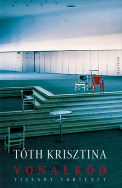 This is the first work in prose from a remarkable poet. It contains fifteen short stories, each having a subtitle containing the expression line/bar. The narrator of the stories is either a young girl or a young woman, depending on the reader’s interpretation of each story, and some may see her as the same person all the way through. However, every action is seen from a woman’s point of view: childhood acquaintances, school camps, love, children, deceit, and journeys set against the backdrop of the ’socialist’ era towards its close.
 Magvető Rights
You must be logged in to post a comment.