

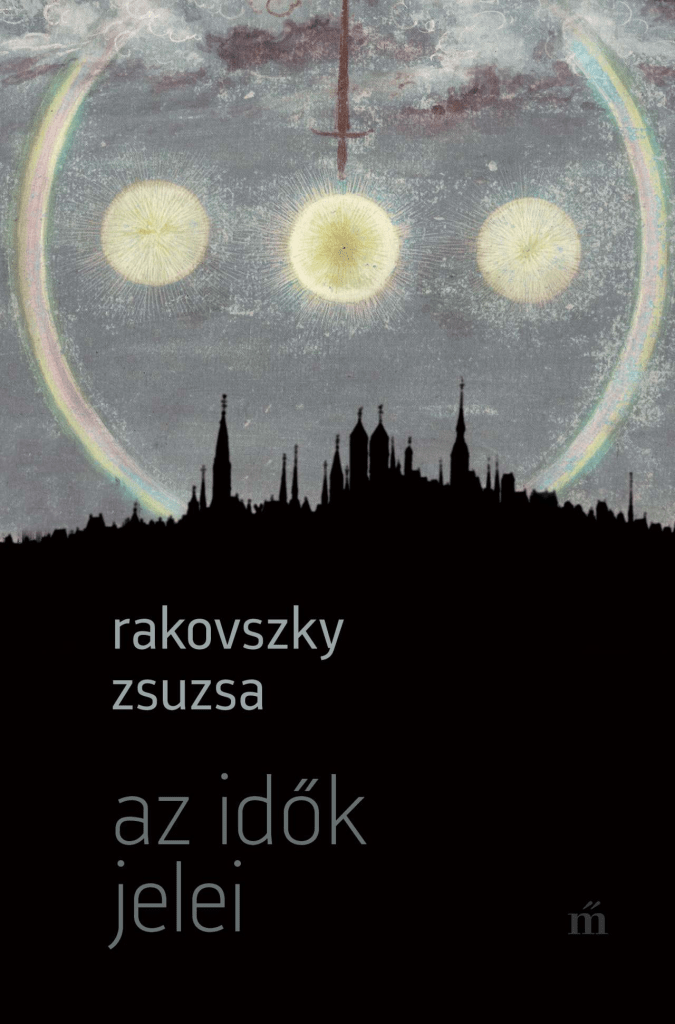
Münster, the 1530s. Tensions are growing between Catholics and Protestants. As emotions are running high, radical Anabaptists seize the city hall, and proclaim that Münster, under their rule, is the ‘New Jerusalem.’
The story of the Münster rebellion – a story of escalating religious fanaticism and revolutionary zeal, madness and terror – is told by an eyewitness, Liza, the mute servant girl, who sees and hears everything. As she cannot talk, people – including her master, Bernhard Knipperdolling, a wealthy patrician who becomes one of the leaders of the rebellion – readily speak their mind in front of her.
Sign of the Times is a historical novel in which almost all the characters are real and the events are true, even the most unlikely ones – the blind belief in two prophets (a former baker and a former tailor), the radicals’ introduction of polygamy, the massacre of the last days, and the gruesome revenge of the expelled bishop. Rakovszky has a remarkable talent for storytelling and for transporting the reader effortlessly into a world long gone, with all its paraphernalia and everyday activities.
However, this is not merely a historical novel: by recounting all the twists and turns of the story of the Münster rebellion as it relentlessly proceeds towards its terrible end, Rakovszky also tells a timeless story that is painfully relevant to our times: she shows how the legitimate grievances of people and their desire for freedom and justice can be used by impostors who, when they come to power, manipulate the people into complying with even the most insane demands.
Product details
ISBN 978 963 1442 37 3
2022, hard cover with jacket
312 pages, 5499 HUF
 Born in Budapest in 1927, Szilárd Rubin lost his mother at the age of ten. His father and other members of his family died by violence. Rubin’s first book, Playing Chicken was published in 1963. Although it went against the expectations of socialist realism, some of his contemporaries immediately realized its value, with writer Miklós Szentkuthy calling the book a “true-blooded, modern Werther.” Playing Chicken was rediscovered in the 1990s. Rubin wrote five books, two of which earned him a late, but worldwide recognition: his unique and concise writing, mixing sentimentality with cruel self-examination has been compared to works of Marcel Proust, William Faulkner and F. Scott Fitzgerald. Rubin died in 2010 in Tapolca, Hungary after a long illness.
 How does a woman arrive at the point of killing her husband? Is her failure due to her body, her marriage or history? Why does she want a child at all costs? And why does society stigmatize her if she doesn’t manage to have one?
 Iván Sándor is a writer, essayist and playwright born in 1930. Laureate of the Attila József Prize (1985), the Sándor Márai Prize (2000) and the Pro Literatura Prize (2001), among others, he has written forty books to date. Several of his books were published in foreign languages; Követés (Legacy) has appeared in English, French and German.
 Magvető Rights
You must be logged in to post a comment.