

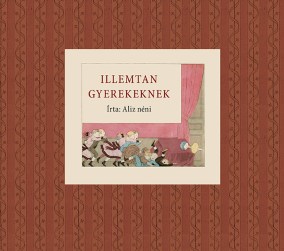
 ‘You should, you shouldn’t!’ How difficult it is for a small child to guess what they are and aren’t supposed to do! If something’s interesting, fun, and makes you laugh, you usually shouldn’t do it; if you’re supposed to do something, it’s incredibly boring. Aliz Mosonyi’s book of etiquette conjures up the old world of children, and the ancient world of adults—though in fact, it is about us. It is an adaptation of a popular, hundred-year-old children’s etiquette book, to which Aliz Mosonyi has added amusing texts for today’s children. She teaches us to wash our hands, blow our nose, greet people, be kind to guests, behave properly at a set table, listen to the teacher, etc., and makes us laugh at those who dry their hands on the curtain, crawl under the table to hide from guests, quarrel, pinch and bite—or simply don’t know how to be bored politely. With the marvellous drawings of the famous French book illustrator Louis Maurice Boutet de Monvel (1850–1913).
How to be bored politely? A very funny self-help book for kids and parents.
For children age 4 and older
Product details
ISBN 978 963 1425 36 9
2006, hard cover
48 pages, 240×210 mm
1990 HUF
Files of illustrations are handed over free of charge
English excerpt available
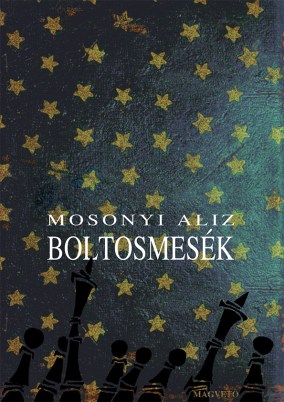 Eighty-one stories about shops that never existed. Though children will love these fairytales because of their absurdity and gentle humour, perhaps they are more for young people who have just begun to face the hurdles and trials of life: love, friendship, confidence, mourning, faithfulness, betrayal, deception, villainy, vanity, and old age. Written in an unmistakable style, with a quick, powerful rhythm and dramaturgy, these stories are perhaps best defined as ‘lyrical grotesque.’ The stories feature shopkeepers and customers, young and old lovers, a miserable shop assistant, devils, a wise doctor, a nasty baker, a talking dog, a shouting dragon, the ghost of a sugar lump, cakes, guardian angels, books, stamps, dolls, buttons, vegetable stews and many more. Shop Stories has been reprinted several times since its publication.
 ‘Once upon a time there was a car. The car belonged to the Old Miss, and it was shiny and clean inside and out, because Miss liked things to be tidy and clean, and she liked her old car too.’ This is how Aliz Mosonyi’s latest stories start—for young and old, drivers and pedestrians, travellers and armchair explorers. You’ll come across drive-in cinemas, a postal worker, a queen, a porcelain dog and a real one, and everything else the Old Miss encounters on journeys in her old car.
 In this story of three generations in a Hungarian village, Oravecz records the history of the disintegration of rural culture. In the author’s native Szajla, a village that has gained almost mythic proportions thanks to Oravecz, we follow the Árvai family, from a grandfather who had fought in the War of Independence against the Habsburgs in 1848 to a grandson who becomes ‘unfaithful to the land’ and leaves the country in hope of a better fortune. A lost world comes alive as Oravecz depicts the life of peasants in stunning detail – everyday life and festivities, birth and death, love and loneliness, as well as the dilemma of staying or leaving.
 This novel is an extraordinary story about an unforgettable woman – a story that took place in the Budapest of the 1940s, full of glamour as well as mortal dangers. In chapters alternating between the past and the present – the grey, boring and eventless Budapest of the 1970s – the author tells the story of Baby Vadnai, a beautiful, rich and fashionable young woman, and the investigations of Dobrovich, a budding writer and member of a ‘tribe’ of young intellectuals in Communist Hungary. Dobrovich and a friend, Doxa, the legendary loiterer, madman and visionary of the ‘tribe,’ suspect they might be brothers, and Dobrovich starts to make investigations about their father. A story of passionate love and hate unfolds, with the milieu of Budapest in the 1940s – the siege of Budapest, the persecution of Jews and the glittering social life of the high classes – in the background. Baby Vadnai is a historical novel in which both wartime and Communist Budapest are powerfully evoked.
 Magvető Rights
You must be logged in to post a comment.